Imagine the Future and Work Backwards

Each one of us is as old as the entire biological kingdom, and our bloodstreams are tributaries of the great sea of its total memory. – J.G. Ballard, The Drowned World

Earlier this year, (I am late in finally moving this post from draft to final form), University of Florida held a fascinating plenary session called “Imagining Climate Change: Science and Fiction in Dialogue” as part of their February 2016 Water Institute Symposium. I was lucky enough to attend this along with several other events meant to foster dialogue about water and water resources.Many of these events embraced the intersection between art and science, with an understanding that the former may have a lot to add to the communication of the latter.

The plenary focused on a panel consisting of scientists and science fiction writers, several who dabbled in the blurred lines between those professions. Terry Harpold, Associate Professor of English at UF, moderated the discussion. Scientists included Ellen E. Martin, a paleoclimatology fellow for the Florida Climate Institute and professor of paleoceanography at UF, and Jay Famiglietti, senior water scientist at the NASA Jet Propulsion Laboratory and an earth system sciences professor at UC Irvine. Rounding out the authors were Yann Quero, Jeff VanderMeer, and Tobias Buckell.

The session reminded me of variations of scenario-based planning exercises we practiced in our conflict management course. The participants can embark on a sort of imaginative course of suggesting possible futures or outcomes. As Kahane (2012) describes the method: “The scenario method asks people to talk not about what they predict will happen or what they believe should happen, but only about what they think could happen.” Different versions of the process have wavered on the importance of plausibility versus probability. But regardless, it lets those involved imagine the future and possibly envision solutions to keep negative possibilities from occurring, or identify steps to support positive scenarios.

Harpold directed the panel first to consider water and its influence on them – “the great solvent of our collective imagination” – and the members described often poignant moments where resource coincided with personal memory. One panel participant, Tobias Buckell, described his youth growing up in the Caribbean and living on boats, a unique perspective that colored his responses to later questions. Dr. Famiglietti was also able to re-iterate a point he has made in the documentary Last Call at the Oasis, concerning his findings of extreme water scarcity in the western coast of the US among other regions, and how his interests have continually moved towards how to relay this topic effectively to the public and outside of the constraints of technical writing.

homeimageicebergs-600x210
Source: http://franceflorida.clas.ufl.edu

The conversation turned to examining the role of writers in contrast to those of scientists, as it was noted that sometimes science writing is not enough, the effectiveness of the translation piece is becoming the defining thing. When asked why writers feel compelled to bring in the science, the French author Yann Quero noted that it used to be the job of the writer to make people dream. It appears however, for some writers, that the looming threat of climate change has made some of them feel a personal onus to translate the sometimes labored language of the science into humanized narratives, crafting stories with probable elements. “Let me grab you by the face and show you how tragic this will be on a human scale” added Tobias Buckell.

It was also suggested that this kind of science-driven fiction can make the lives of scientists more relatable by conveying their lives and the constraints they work under. Ideally, this would make the efforts of researchers like Dr. Famglietti and Dr. Martin easier. But it is also clear that scientists are operating under a different set of constraints with regards to communicating the science of climate change, as became very evident when the topic of uncertainty was posed to the panel.

Dr. Martin referred to the perception of there being gatekeepers of scientists and publishing, certain thresholds that needed to be met before scientists were let loose to communicate. Further discussion established that fiction had the luxury of being able to exist within a different convention of reliability. However, when the question was posed about how much uncertainty needed to be minimized before action was taken,  Dr. Famiglietti recounted (I saw him in multiple contexts, so this comment may have been made at an earlier event) attending a meeting where Al Gore was speaking and proceeded to lay out a directive for the scientific community to embrace the responsibility of sharing their science, as no one else knew their data with the same intimacy, or perhaps understood with the same gravity, the messages their research was revealing. If there was a preponderance of supportive data, more harm than good could be done waiting to to reach a 98% confidence threshold.

Additionally, scientific jargon and word usage can be misconstrued. The public may hear the word “error” and understand it to mean “wrong”, when in a scientific context, it may in fact refer to the process of getting closer and closer to the correct answer.  So there is the challenge of choosing how to effectively relay the larger messages. Alternatively, authors were asked how or if they maintain scientific rigor within their text, while still subscribing to the creative process of writing fiction. One of the more interesting responses came from weird fiction (an actual subgenre of speculative fiction, not my classification) author Jeff Vandermeer who suggested fiction doesn’t need to solve the questions  it poses, as we often can’t in real life. He also referenced the writer J.G. Ballard, author of “The Drowned World”, who engages his reader in thought experiments. How is the human mind altered by climate change? Perhaps you don’t need to even characterize the change correctly, the power is more in the act of considering it.

The panel ended by gauging the level of hope panel participants had for the future, as  moderator Harpold suggested “hope is a deeply irreducible human thing…” The tone of responses was one of adaptation rather than complete mitigation. There are no absolute solutions, but we would be remiss to do nothing. Dr. Famiglietti recognized the irreversible trend associated with some aspects of climate change but voiced his hope in future communities to develop sustainable ways to manage resources. Vandermeer suggested we not engage in magical thinking and shy away from the complexities of climate change, but may need to instead redefine our vision of utopia. Also acceptance that our current way of life is dead leaves us room to engage in new ways of living, that we we need to become less to become more. From his own experiences, Buckell has been led to believe we are far more likely to come together to rebuild and recover, in contrast to the “rugged individualism” Hollywood has led us to believe characterizes natural disaster.

All in all, the session an intriguing look into the minds of a group of men and women who have devoted a significant part of their lives to considering the implications of climate change. It is certainly a heavy task to engage it, but one they are clearly doing so with thoughtfulness and conviction.

Speck of Science – 4/19/16 – March of the Crabs

christmas-island-red-crab
Source: Animal Planet

Mass migrations fascinate me – massive swarms of creatures on robotic treks to satisfy deep-seated needs for resources – nature’s automatons reaching for food, for mates, for brighter skies. One of the earliest that captured my attention is expressed in this Animal Planet video documenting the movement of red crabs on Christmas Island:

http://www.animalplanet.com/tv-shows/wild-kingdom/videos/christmas-island-red-crabs/

(Note at 1:40, crustaceans seem to be playing “frogger” while obliviously scuttling across roads and railroad tracks. Not the unexpected result of the clash between crab and human.)

A gif of the oceanic equivalent has made a recent appearance online, showing an endless carpet of sandy colored scuttlers (they were in fact red,  or “tuna,” crabs who appeared that way as they stirred up a the sediment on the sea floor). However, this article sheds more light on the unusual event captured by a manned submersible exploring Hannibal Bank off of Panama (fitting name for the location of a slightly unnerving and intriguing event to occur? ). The following video comes from Woods Hole Oceanographic Institut and features scientist Jesús Pineda explaining the details around recording the migration:


Speck of Science – 4/6/2016 – Gimme Back My Buoy

I have been through a blogging dry spell lately, but nothing like starting out again with the amusing news of 2 men essentially holding a USGS (United States Geological Survey) scientific buoy hostage.

cce-map
A Map of the Monterey Bay Aquarium Research Institute’s Coordinated Canyon Experiment. The buoy was associated with this particular project. Source: MBARI

The buoy, which was deployed to gather data related to El Niño events, drifted off its mooring during a recent storm. Two fishermen chanced upon it, recovered it, and are now demanding $13,000 in exchange for its return. Their lawyer, a seemingly rather colorful character and self-described “old trial dog”, initially set the price a bit higher based on the following mathematics: ” On good days fishing they gross $2,700. Taking the big and gouging thing onto the boat and having it there kept the boat out of action for nine days for a multiply of $24,300. Twenty percent of value would be $80,000. We offer to SELL (you can use any other word you like in an agreement) it to you for $45,000.” One has to wonder why they took it upon themselves to keep the “big and gouging thing” on their boat for nine days in the first place.

The article notes from several sources that salvage laws likely do not apply here, especially as the buoy was never properly abandoned. However, the loss of and tampering with of expensive research equipment has always been a known and pervasive issue in oceanic research.  I for one will be interested to follow the outcome of this eyebrow-raising case.

David Attenborough Says Hello

David Attenborough’s voice was the seminal soundtrack to my development as a biologist. It was his narration I heard in my head extolling the wonders of the living things I saw during my scuba dives, fieldwork, and time spent outdoors.

So it may amuse you that it is not the news that Sir Attenborough plans on narrating a decade-later follow up to BBC’s Planet Earth that excites me, but rather the discovery that this video of the renowned naturalist himself providing commentary of the beginning of Adele’s “Hello” exists:

#flipphone y’all

5 Examples of the Revolution of 3D Printing in the Sciences

Here is a quick list re-visiting some of the more innovative and thought-provoking applications or ideas surrounding 3D printing in the sciences over the past few years:

1-intro
Credit: Wake Forest Medical Center
  • Printing human tissue. Recent news shows we’re able to use 3D printing more effectively to create intricate models of organs for learning purposes. However, a smattering of experts across disciplines have made progress in printing processes that utilize the stuff of the human body to create swaths of tissue that can be used for grafts or testing. The purported next step is the more complex arrangement of tissue into whole organs that are custom designed for the patient, limiting the possibility of rejection and alleviating the long wait times on transplant lists.
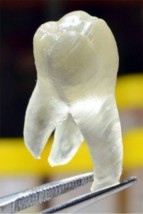
  • printedteeth1-143x214Antimicrobial teeth.  A boon to those of us with an arduous dental history, the development of bacteria-resistant tooth implants may be more than a distant fever dream. Dutch scientists have printed and initially tested tooth prototypes against human saliva, but are still a ways off from starting patient trials.
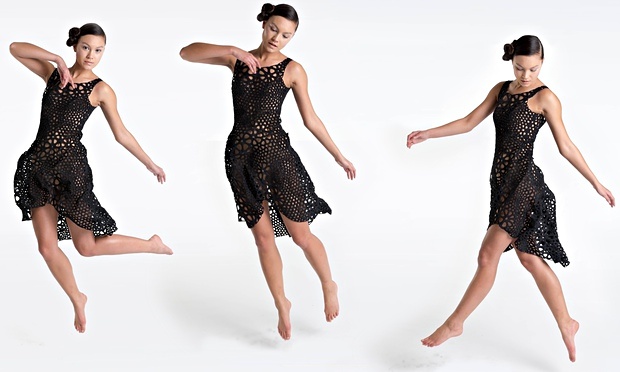
  • Smart textiles. When it comes to wearables, 3D printing is appearing in some surprising ways. Take this architectural swimsuit top meant to help clean the ocean  by locking aquatic contaminants away in its fabric. Or this Anouk Wipprecht design of a “spider” dress that responds to the wearer’s emotional state. A great deal of industry seems to be focused on the concept of wearable electronics, which is sure to gain momentum from the recent production of a flexible graphene fabric.
4D-dress-012
4D Dress, Photo Credit: Steve Marsel Studio
  • The advent of 4D printing. Harvard researchers have revealed new research of 4D printing techniques that allows for the creation of materials that can interact with their environments and can experience temporal changes (thus adding a fourth dimension to 3D applications). They have developed mathematical models that can suggest exactly how the material is to be printed in order to produce the desired changes in shape. One of the primary suggested uses for 4D printing is the fabrication of self-building objects. But as presented in the photo above, the world of 4D printing and haute couture is also colliding.
  • Printing custom drug formulations. Lee Cronin at Glasglow University, as told to the Guardian in 2012, envisions a day where we would be able to print our prescriptions at home. The New York Times recently released this article about the continuing challenges of drug shortages that can arise from impacts to manufacturer facilities, or when drug production is limited due to concerns about bankability. The ability to more easily synthesize medical compounds could revolutionize the pharmaceutical industry.

Intersect (Art & Science) #1 – The Introduction

2011-03-08-science_wonder_art

I love art and every recondite and consuming idea it can encompass. But what really fascinates me is the porous little spaces where we examine or redefine the steady and concrete components of the world through an artistic lens. Also, the scientific world is surprisingly replete with individuals who are well tuned into their right-brain tendencies. The scientific process requires a surprising amount of creative thinking.

So with that introduction, I’d like to occasionally share ideas, art, and artists that strike me as passing back-and-forth through that veil.

One of my favorite places for finding inspiration is the Harn Art Museum at the University of Florida where I go to school. They even regularly host nights specifically to feature scientists who have an artistic bent.

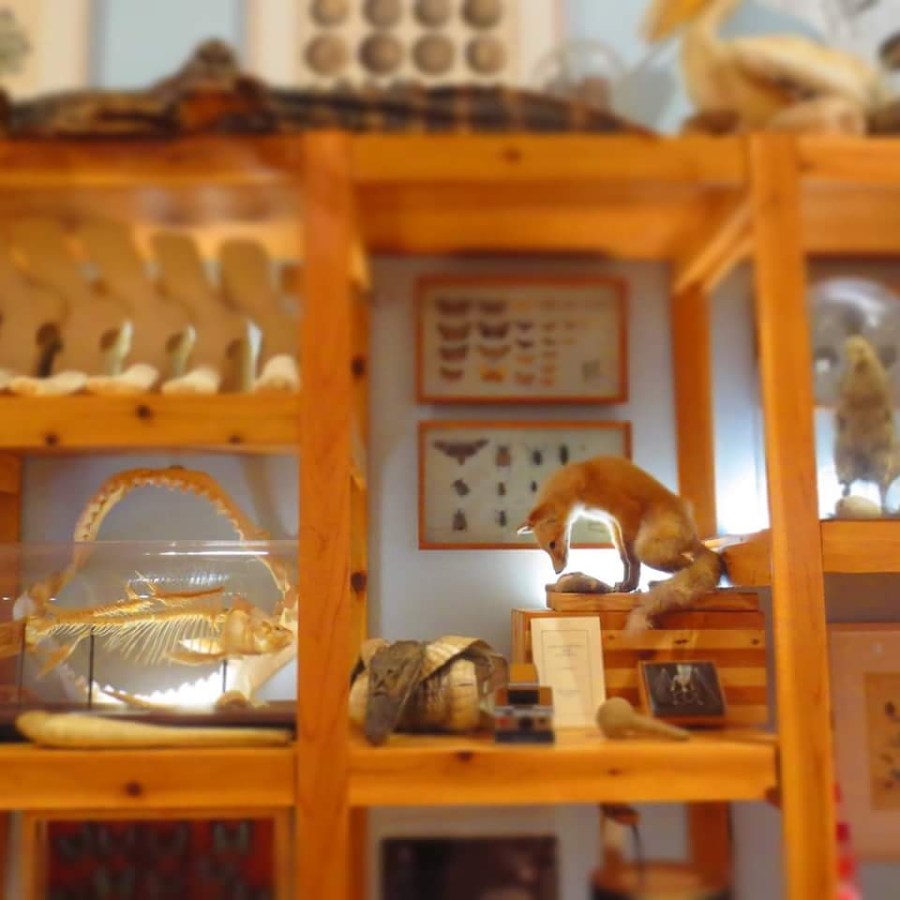
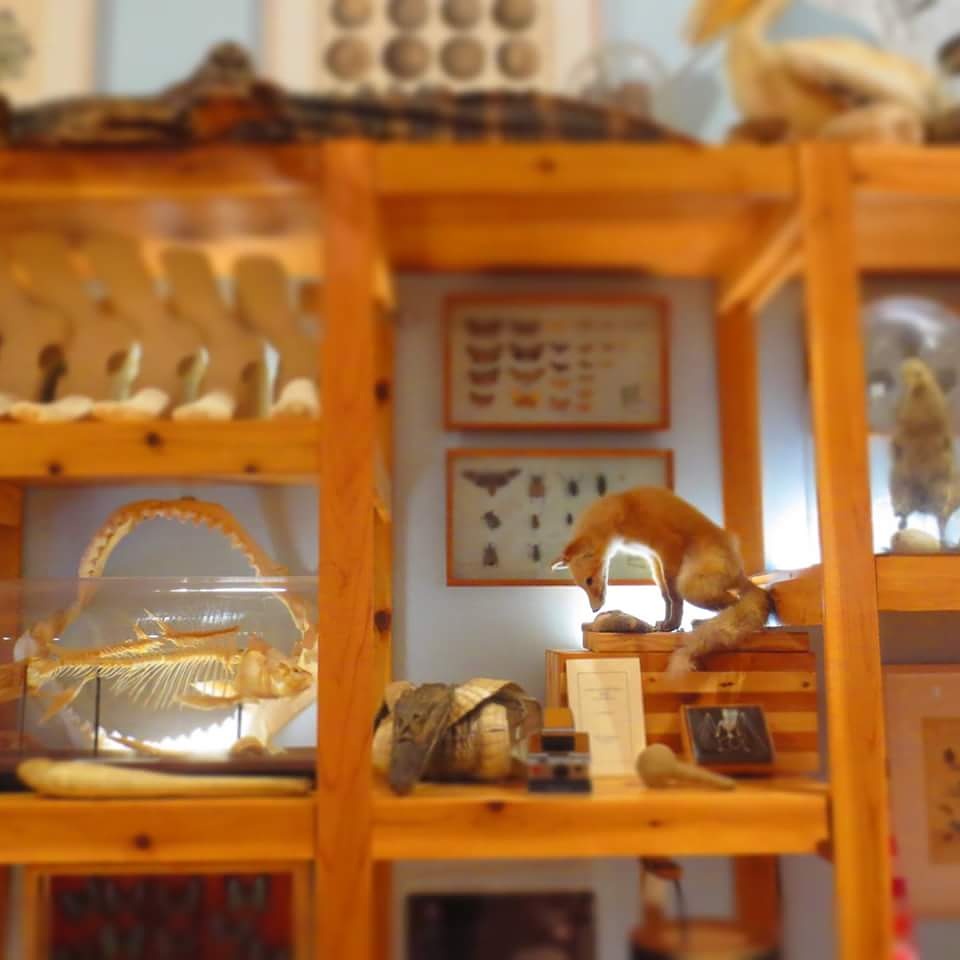
To start off, the following photo was one I took from their 2014 exhibit: Repurposing the Wunderkammer, Building A New Space for Science and Art. As they explain here, the Wunderkammer were essentially collections of wonder, comparable to cabinets of curiosity. The specific piece represented below was titled the “Last Whole Earth Cabinet” and as constructed/curated by artist Sean Miller. 

image

What a job to try and catalog the world, with only a few small shelves to fill with its treasures.


Depth of Field #3: She’s a Mysterious Kind of Ship

IMG_4732.JPG
Photo Credit: Carrie Schuman

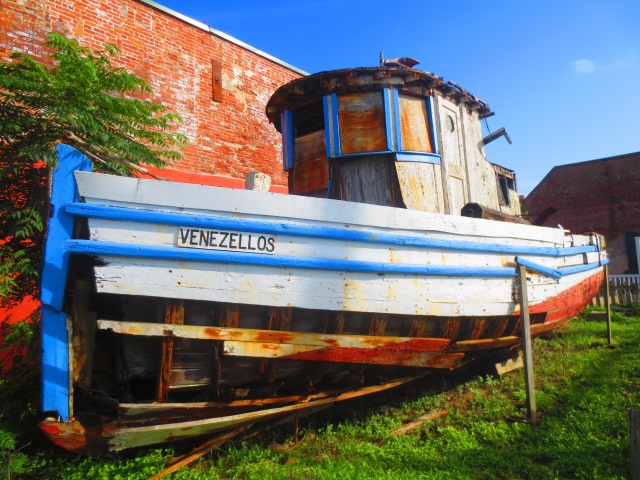
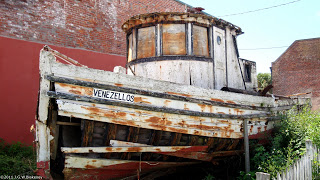
The Venezellos is propped up and displayed down a lonely side street in the Florida Panhandle town of Apalachicola. Online searches reveal little about its past lives, and it’s likely one would have to make a note to ask the local residents to find out much at all.

However, perhaps she has general significance of the fishing legacy Apalachicola and many other coastal Floridian towns share.

While the boat has never been completely repaired/restored, perhaps in order to retain original planking and materials, it’s clearly received a fresh coat or two of paint since 2011 when Grant Blakeney posted the following photo on his blog:

venezellos

A google search of the name “Venezellos” suggests a spelling correction of Venizelos which is characterized as a Greek surname, one that has been associated with several well known Greek politicians. This finding only seems to deepen the mystery and enigmatic nature of this remarkable nod to the past.

Depth of Field #2: The Sea Hare Emerges

IMG_5115
Photo Credit: Carrie Schuman

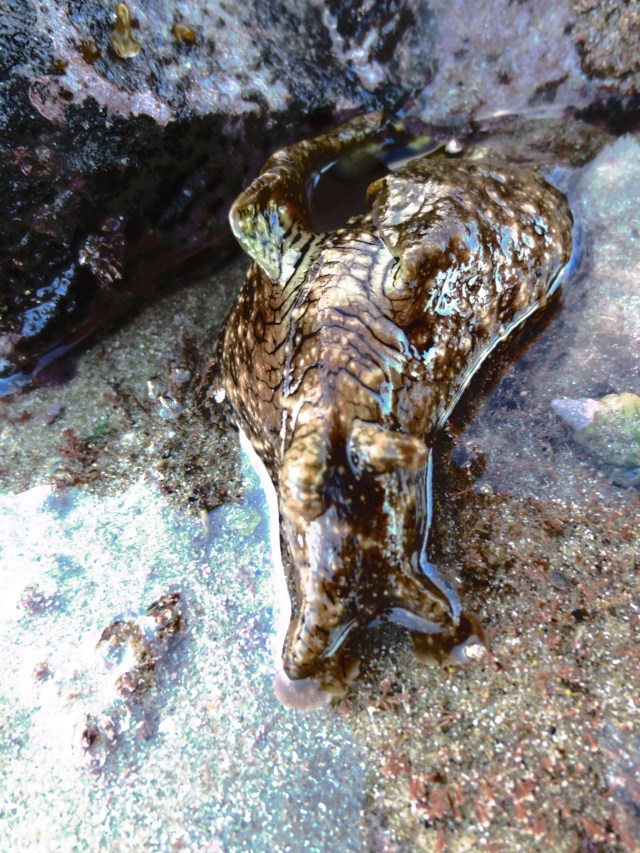
The sun is starting to set on expanses of mirror-reflective tide pools speckling the beach of the Tawharanui Marine Reserve in New Zealand. I’ve been walking along staring into them at random in my search for anything novel when I chance across what is at best guess an example of Aplysia dactylomelathe variable sea or spotted hare.

In a surprising contrast to the small chitins, tunicates, and other finds, the sea hare was relatively large, measuring somewhere in the range of 5 to 6 inches in length. As seen in this additional photo, a smattering of spots can be seen along its body:

IMG_5119.JPG
Photo Credit: Carrie Schuman

According to this source, sea hares are hermaphroditic though they do not practice self-fertilization. They may often form reproductive “chains”.

As suggested by one of their common names, they may be highly variable in appearance with their coloration primarily determined by the type of algae they feed on.

They release a purple dye as a mechanism to surprise and confuse predators. This particular characteristic was one I had once experienced first hand when handling my first sea hare in the mangroves of Key West. It certainly has a startling quality to it.

Variable sea hares tend to be more solitary, and nocturnal in nature. So perhaps no small amount of dumb luck governed this thrilling little chance encounter.


Aplysia dactylomela

Speck of Science – 1/11/2016: The Co-evolution of Poachers

I’m a little late in posting about this story that came out in the Guardian on New Year’s Day.

4288
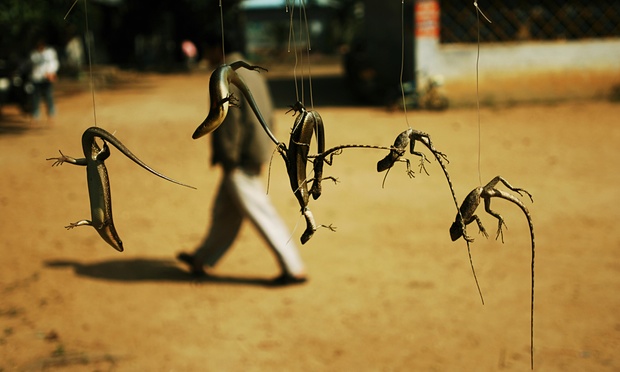
Colour changing tree monitors or garden lizards annd Bronze skinks hung in a street market to be sold as pets in Hainan province, China. Photograph: Xiao Shibai/Alamy

The gist of the piece is that the journal Zootaxa has published recent papers omitting the data on where the described species may be found. This is to deter impact to these newly described organisms, after several incidences where animals were depleted or found for offer in the pet trade. This goes to show that seemingly the most innocuous and standard scientific practices (in this case, the standard documentation and provision of data surrounding the description of newly identified species) may still warrant ethical considerations.

This also represents an interesting and alarming co-evolution of illegal or unregulated poaching practices. But this is just a drop in the poaching bucket, as poachers have already clearly upped their game in recent years, arming themselves with high-tech equipment like night vision goggles. However, there is a whole range of combatant technologies emerging for use in the anti-poaching effort being billed as “smarter ways to fight wildlife crime.”


Speck of Science – 1/7/2016: Aye Calypso

Sometimes I come across some interesting news item that I don’t have time to write about in depth but still want to share. I’ve decided to start a new Speck of Science feature on my blog as a way to share brief blips and recaps of internet curiosities and dispatches.

calypso-at-sea-100610-02

Today’s item is an article from the Guardian reporting that Jacques Cousteau’s ship, the Calypso, will soon be ready to begin life anew. The ship was downed by an accident and since 2007 had been languishing in a sort of boatyard purgatory due to disagreements over payment and the purpose of its restoration. This is truly exciting news for the continuing legacy of marine exploration, and our care for the world’s oceans.