Depth of Field #1: Coquina and the Palm Coast

“Photography is the only language that can be understood anywhere in the world” – Bruno Barbey

IMG_0958

So I’m one of those people who use facebook as an image repository – a sort of dusty social media shelf where I can look back and browse through digital photo albums filled with virtual Polaroids (I grieve the fact I never owned a Polaroid camera). However I recognize that the often interesting stories related to these images are buried relatively quickly.

This is the first entry into what I plan on making a regular feature (perhaps weakly-ish?). I will unearth what will generally be a nature or ecology-centric photo and jot down a few words about the context in which the photo was taken. If nothing else, I think this develops some nuance to my interest in cultivating a presence as a science communicator.

The first photo I’m featuring is taken very near where I work on my dissertation research. The shoreline is from Washington Oaks State Park in Palm Coast, Florida – a half hour or so south of St. Augustine. This was winter in Florida which is still punctuated by the vibrant green of algea growing on coquina rocks.

Coquina is a very marine phenomenon – the sedimentary rock consists primarily of Donax variabilis shell – the tiny little Coquina clam. Shells originating from other molluscs and invertebrates may join the mix. The rock was used for many of the Spanish Colonial structures – primarily forts – in the St. Augustine area.

One of the most notable and striking features of the Coquina are the circular depressions weathered through the rock. The shells that comprise the rock are largely composed of calcium, making Coquina a type of Limestone, which is relatively soft and easily shaped by the elements and other influences. A couple sources I’ve found suggest these holes are from Coquina forming around cabbage palms at one time. They certainly make for a visually arresting landscape.



The Weird and Wonderful World of the Water Bear

42-26772123
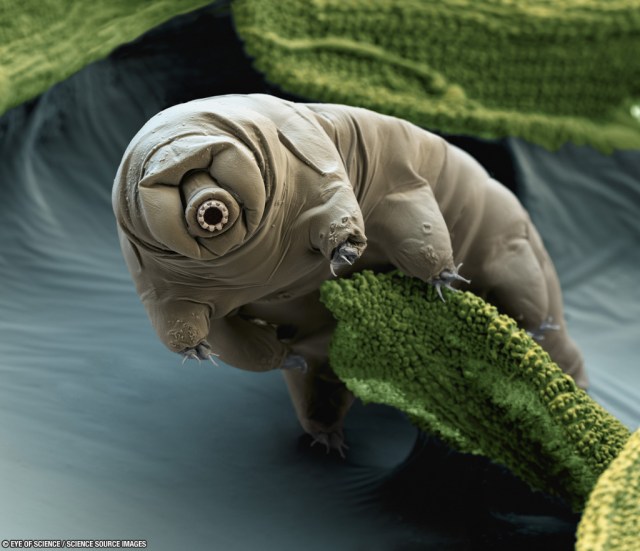
Photo Credit: Steve Gschmeissner/Science Photo Library/Corbis

I have long been fascinated by water bears (also known as tardigrades, and more amusingly and infrequently as moss piglets), though I have yet been lucky enough to see them for myself, wandering about their microscopic worlds.

However, they have been items of interest as of late due to some of their more bizarre qualities. (I like to think of them as literal inclusions in the news, wandering about among inky words on printed pages). If the distinction of being able to survive in the vacuum of space along with other extreme environments wasn’t enough, it was recently revealed that they have an inordinately high amount of foreign DNA in their genome – almost 18% relative to many organism’s 1% – earning them the playful moniker of “DNA thief” in articles on the subject.

Water Bear

Much of this extra DNA may be incorporated into the tardigrade’s potential tool kit during periods of desiccation. Water bear DNA is suspected to actually sheer and fragment when dried out, and to reassemble once re-hydrated. This period of genome construction probably provides ample opportunity for stray genetic material to sneak in.

Researchers have also recently discovered more about how water bears may cope with this extreme drying out and jumbling of their genetic material. Apparently these bitty creatures produce a sort of “bioglass” that coats and protects their cellular contents.

So along with discoveries of new members of the water bear extended family, there’s no doubt there are many strange revelations to come concerning these curious creatures.

Updated note: Thanks to Robie and her comment below. Turns out there is some conversation occurring right now with regards to whether the figure of ~ 17% foreign DNA is, in fact, accurate. So while it may take a little time for researchers to suss out the truth of the matter, this is an interesting insight into the tug and pull of the scientific process.


Whale Tales – Current Cetacean Communiqués

Orcas as captured by drone surveillance. Photo credit: NOAA, Vancouver Aquarium.

There’s been a couple interesting whale-centric stories I’ve come across lately, so I thought I would share on the blog.

While the idea of drone surveillance is proving to make a large part of the public uncomfortable, the technology is proving to have less pernicious applications in observing natural phenomena.

Southern resident orca calf nursing. Photo credit: NOAA Fisheries, Vancouver Aquarium.

With regards to whales, drone footage of southern resident orca pods has recently been captured by a collaborative effort between the Vancouver Aquarium and NOAA (National Oceanic and Atmospheric Administration).  NOAA recently released beautiful close-up photos and a video conversation with ecologist John Durban giving some additional context to the what the drone captured.

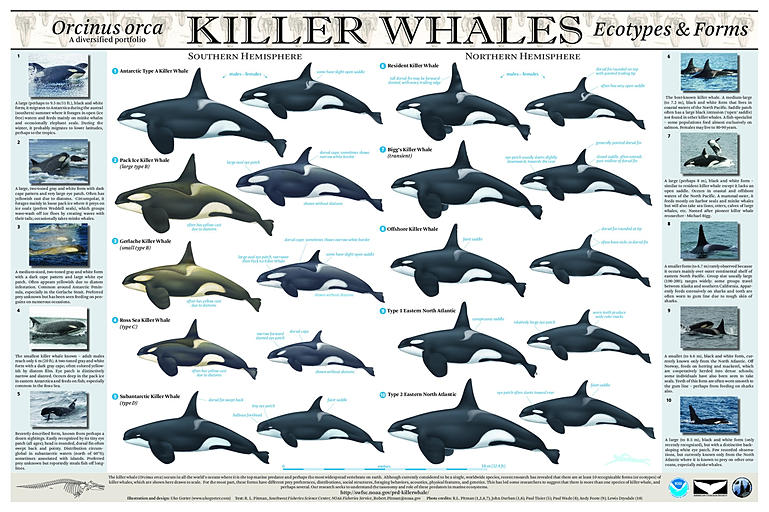
Over more recent years with advances in genetics and stronger observational data, it was determined that orcas are not a uniform species and instead vary with regards to morphological characteristics, ecology, and behavior, generally referred to as “ecotypes”. The southern resident population of killer whales numbers about 81 individuals. Aerial footage provides a relatively non-invasive way to study and collect data on these animals.

Read more about the study and about “mobly”, the hexacopter used to study these creatures, here.

Another fascinating footage find was this picture posted of an albino southern right whale calf off the coast of South Africa:

Anton Schutte was alerted to its presence by a tourist he had recently befriended and was able to snap pictures and video of the blindingly white baby whale.

Omura’s whale lunge feeding. Photo Credit: Cerchio et al 2015.

Lastly, Discover Magazine released an interesting news bit based on a recently published paper about the Omura’s whale. This whale wasn’t classified as its own species until 2003, and was described based off of samples from carcasses that had washed onto beaches. Scientists spotted living populations off of Madagascar and were able to genetically validate the sighting as Omura’s whales. Surveys were completed over a course of 7 years in order to learn about their ecology and behavior.  They have rorqual pleats like those seen in humpbacks, that allow them to “lunge feed” – quickly engulfing large masses of water and using their baleen to assist with filtering out their prey items. They sport an asymmetrical white patch on their lower jaw, much like Fin whales. They also likely do not wander far from their home base.

Hope you enjoyed the updates. Until next time my friends!

A Vast Solar System: To Scale

I adore those simple science-based moments where someone gets me to stop and exclaim “huh”… Maybe it’s an upset of pervasively incorrect ideas about how the world works (See Radiolab’s Robert Krulwich’s fervently amused post regarding the true supposition that trees get most of their mass from air rather than the ground), or just a mild re-positioning of the nuances to how we see things.

Apparently all those beautiful little models of spangly little planets in orbit around one another are overwhelmingly flawed. Not surprisingly, if everything were to scale, the planets would both be greatly farther apart and almost microscopic in appearance relative to how they are often depicted. While I was aware of the need to bend some of these rules in order to allow us to develop a reasonable mental model of the solar system, I don’t think I would have appreciated the reality without a little help.

Luckily, filmmakers Wylie Overstreet and Alex Gorosh have filled that void by creating an elegant little video where they model the real relative sizes and distances of our planets  in the desert (albeit while Pluto was demoted to “not a planet”). Watch below and ruminate while we all rotate on this pale blue dot: